

Beyond the Credential: Why NAPSA Certification Matters to the Future of Pretrial Services

I’d like to talk with you about the intersection of public health and the criminal legal system—specifically, behavioral health and pretrial services. People detained pretrial make up a significant portion of the population in our nation’s local jails. We also know that behavioral health needs are highly prevalent among people who come into contact with the criminal legal system, including substance use disorders and mental health conditions. Often, these needs occur together. For purposes of this discussion, I will refer to them as co-occurring disorders . Those statistics matter, but the people behind them matter even more. Looking Beyond the Charge Many people entering the pretrial system face charges that do not necessarily indicate a high likelihood of new criminal activity or failure to appear. When validated pretrial assessment tools are appropriately used, they can help practitioners and courts identify individuals who have a high likelihood of remaining arrest-free and returning to court while their cases are pending. Put positively—as we are increasingly learning to do—many of the people we encounter have a high likelihood of succeeding in the community while awaiting trial. Yet many people remain detained. Courts may believe that setting what appears to be a relatively low monetary bond—$100, $250, or $500—provides a reasonable path to release. Those of us working directly with pretrial populations know that even a seemingly small amount can represent an insurmountable barrier for someone experiencing poverty. For a person choosing between rent, food, transportation, medication, or other basic necessities, there may simply be no money available for bond. Poverty does not exist independently from health. When people experience poverty, they are more likely to face unmet social determinants of health—the conditions in which people are born, live, learn, work, and age that influence their health and well-being. Those needs may include: Access to safe and stable housing Reliable access to food and clean water Transportation Employment and economic stability Access to physical and behavioral healthcare Personal and community safety Social connection and support Now picture yourself on one of the hardest days you have ever experienced. Maybe it was a final exam in college. Maybe it was going through a divorce. Maybe it was moving your family from one home to another or losing someone you loved. Now imagine navigating that same experience without stable housing, reliable transportation, employment, education, financial resources, or a strong support system. Then imagine doing it while also experiencing a serious mental health condition, substance use disorder, or both. How much harder would that hardest day become? A Public Health Issue Within the Criminal Legal System I believe it is incumbent upon us as a field to look closely at the prevalence of behavioral health needs among people entering our jails and pretrial systems. When we see the same challenges repeatedly—untreated mental health conditions, substance use disorders, housing instability, poverty, food insecurity, and limited access to healthcare—we should ask whether we are responding to an individual criminal legal problem or seeing the consequences of much larger public health and community challenges. That distinction matters. If we understand these challenges partly through a public health lens, our response begins to change. Instead of asking only, “What condition should we impose?” we can also ask: “What does this person need to succeed?” And then: “Does that need require a court condition, or is it something we can offer voluntarily through supportive services?” Those are very different questions. Treatment Should Not Require Incarceration For far too long in the United States, jails and other parts of the carceral system have become de facto points of access to behavioral healthcare for people who were unable to obtain adequate services in their communities. We have all heard some version of the same statement: “What is the largest provider of mental health services in our community?” Too often, the answer is the local jail. In Maine, where I work, that conversation frequently points to facilities such as the Cumberland County Jail. But consider what that really means. Think about the people in your own life who have never been involved in the criminal legal system. How many take medication for depression or anxiety? How many receive counseling? How many need medication or other support to focus, function, sleep, work, or manage daily life? Probably more than we realize. Now think about people you know who live with serious and persistent mental health conditions and have never been arrested. We understand that they need healthcare. Why should our understanding of behavioral health fundamentally change when the person needing care has also come into contact with the criminal legal system? Jail should not have to become the gateway to treatment. Support Without Turning Support Into a Condition Our country is moving—far too slowly, in my estimation—toward a model that better recognizes the value of supportive services for people involved in the pretrial system. The idea is relatively simple: we can help people access what they need without automatically turning every service into a condition of release. I strongly support that approach. At Maine Pretrial Services, we have been doing versions of this work for 40 years. We may not always have had a particular name for it. If pushed to describe it, I might simply call it humanity . If you met someone who had very little and you had access to resources that could help, what would you do? You would ask: “What do you need?” You might follow that with: “What can you do, and what can I do to help?” Sometimes people need treatment. Sometimes they need housing. Sometimes they need transportation, identification, food, medication, or help understanding where they are supposed to be next. Sometimes they simply need someone who knows the system to point them in the right direction. That is support. It does not always have to become supervision. Navigators—and a Larger Purpose That brings us to the growing role of navigators . Navigators can be tremendously valuable, particularly when systems are complicated and resources are fragmented. But I believe we should challenge ourselves to think beyond helping one person navigate a broken or disconnected system. What if navigation also helped us identify where the system itself needs to change? If we repeatedly encounter people who cannot find behavioral healthcare, that tells us something. If we repeatedly encounter people without stable housing, that tells us something. If transportation consistently prevents people from reaching treatment, employment, or court, that tells us something. If people routinely enter jail because community services were unavailable long before their arrest, that tells us something too. Instead of addressing each issue only after an individual has been arrested and detained, we should also be asking: What does this community need to better support the people who live here? That is the larger purpose. If communities are supported, funded, connected, and trained to respond effectively to behavioral health and social needs, they can become the center of service rather than relying on the criminal legal system to fill gaps it was never designed to fill. Moving Upstream I believe we need to move upstream. We should not wait until someone's needs have gone unmet for so long that crisis becomes the point of intervention. We should not wait until housing instability becomes homelessness. We should not wait until an untreated behavioral health condition becomes an emergency. And we should not wait until someone enters the criminal legal system before they can finally access help. The consequences of unmet needs do not necessarily stop with one person. Persistent poverty, instability, trauma, and lack of access to care can affect families and communities across generations. I was fortunate. My parents grew up during the Depression, but they had enough. And because they had enough, we could keep our eyes open and our bodies moving forward. We could go to school. We could work. We could contribute. When you do not have enough—enough food, enough safety, enough stability, enough healthcare, enough opportunity—it becomes extraordinarily difficult to do those things. We can change that. The Role of Pretrial Services None of this means pretrial services should become the behavioral health system, housing system, public health department, or social services agency. It should not be up to pretrial services to fix every unmet community need. But pretrial professionals occupy a unique position. Every day, we see where systems connect—and where they do not. We see the person who could succeed in the community if transportation were available. We see the individual whose behavioral health needs existed long before an arrest. We see the person whose housing instability makes nearly every other part of life more difficult. We see what happens when community resources are available. And we see what happens when they are not. That perspective gives our field both an opportunity and a responsibility to contribute to the conversation. We can build partnerships with public health agencies, behavioral health providers, housing organizations, peers, community-based organizations, and other local resources. We can offer voluntary connections to services without unnecessarily transforming every need into a court mandate. We can collect and share data about the barriers we repeatedly see. We can ask whether our practices support successful pretrial outcomes while preserving the presumption of innocence and using the least restrictive interventions necessary. Most importantly, we can use our proximity to the issue to advocate within our own systems for a different way of thinking. Start upstream. Build communities in which people can access help before crisis becomes criminal legal system involvement. Make treatment available because someone needs treatment—not because someone has been arrested. Create systems where support is truly support. It should not have to be the responsibility of pretrial services to solve these problems. But, as always, pretrial services aims to assist. And because we have such a close perspective on these issues, I call upon us to be among those who help change them. About the Author:
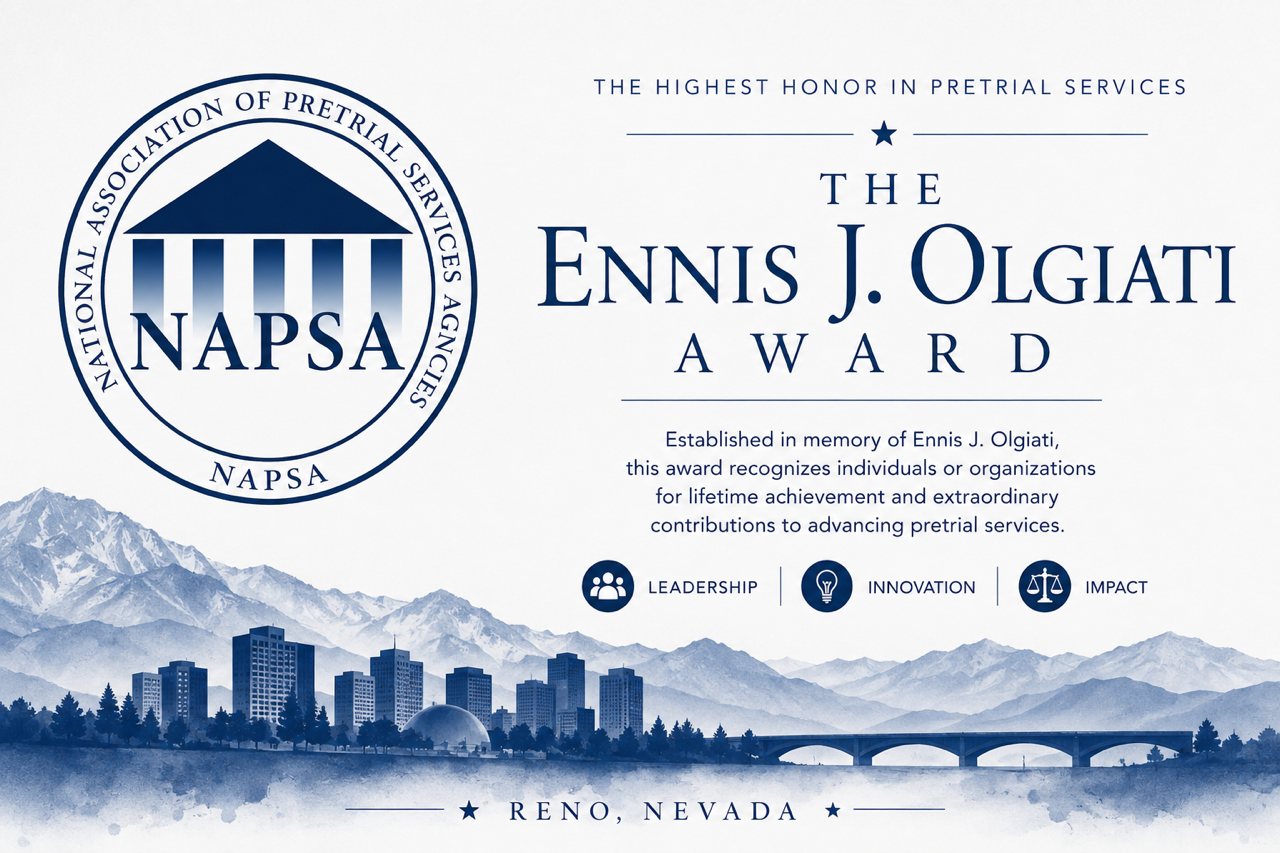
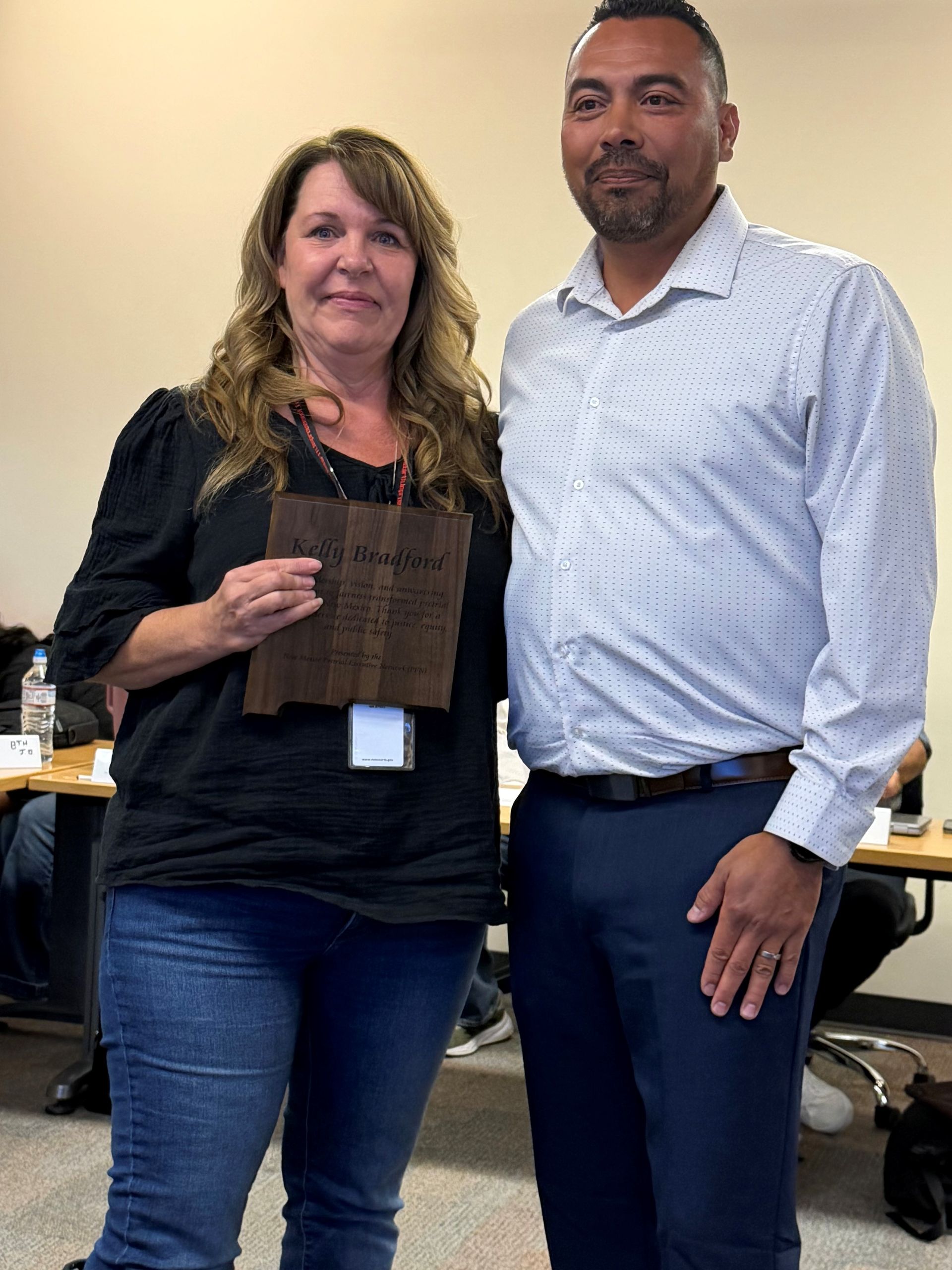
An association says a lot about itself through the people it chooses to honor. The Ennis J. Olgiati Award, established in memory of Ennis J. Olgiati and first presented in 1983, is the highest honor bestowed by the National Association of Pretrial Services Agencies (NAPSA). It recognizes individuals and organizations whose lifetime achievements have made a lasting impact on the field of pretrial services. This year, NAPSA had the privilege of adding Tim Schnacke to that remarkable group. For those of us who know Tim, have learned from him, called him with a question, sat through one of his trainings, read his work—or received one of his famously detailed emails—it is hard to imagine someone more deserving. It is also hard to figure out where to begin when describing his impact. Tim has spent decades helping our field understand not only what we should be doing, but why. He has pushed us to understand the history behind our practices, the law beneath them, and the principles they are supposed to protect. And he has never been afraid to tell us when he thinks we need to look again. As Kennedy Spurgeon said in honoring Tim: “An Association says a lot about itself in the people it chooses to honor.” Kennedy went on to describe what selecting Tim says about NAPSA: that we respect our history, that we want to understand the legal and practical underpinnings of our work, and that we value those willing to carry the message of pretrial justice into places practitioners cannot always reach. And perhaps most fittingly for Tim, it says we don't mind “having our assumptions challenged if it shows a better path forward.” Anyone who has spent much time with Tim is probably smiling at that last part. Tim the Professional Mike Jones describes Tim as “easily the foremost pretrial legal scholar of our generation.” That is a big statement. But look at what Tim has done. His scholarship has influenced some of the most prominent university law professors writing about pretrial law. His work has helped shape legal thinking in bail litigation across the country, including cases before state and federal courts. His scholarship has influenced portions of the NAPSA Standards. For more than 15 years, Tim's work has also helped guide publications, trainings, and technical assistance provided through the National Institute of Corrections (NIC) and the Bureau of Justice Assistance (BJA). And at the state and local level, Tim became the person people called. Line staff. Executives. Attorneys. Judges. Policymakers. Practitioners. When someone needed to understand pretrial law—or, as Tim often reminds us, “Bail and No Bail” —Tim was there. As Mike put it: “There might not be another attorney, or any professional, who has done even one of these things. Tim has done them all.” But Tim's contribution has never been just about knowing the law. It is about the way he thinks. Tim sees things other people don't always see. He can take history, law, policy, research, and practice, find connections between them, and turn those connections into ideas that practitioners can actually use. Mike describes Tim as one of those rare people whose mind truly lives “ on the balcony”— someone able to see both what is happening right in front of us and the much larger picture. And Tim has used that perspective to ask our field some difficult—and necessary—questions. He has never been particularly impressed by the explanation, “Well, that's the way we've always done it.” Instead, Tim asks us to go back to the law. Go back to the evidence. Go back to history. Go back to the principles we say we believe in. Sometimes, after pages of research and discussion, Tim can bring all of that complexity back to one remarkably simple idea: “Bail means release. No bail means no release.” That ability to strip away years of assumptions and return a complicated issue to its fundamental legal principle is quintessentially Tim. And it has changed the way many of us understand our own systems. From Scholarship to System Change Tim's ideas have never stayed confined to journal articles, conference sessions, or training rooms. They have changed systems. New Mexico provides one powerful example. When New Mexico became one of the first states in the country to move toward an in/out model of pretrial release, the state was entering new territory. There wasn't a roadmap. Tim worked alongside the late Justice Charles Daniels and the New Mexico judiciary as they figured out what that new system should look like. And in typical Tim fashion, he didn't help once and disappear. He kept coming back. He trained. He answered questions. He worked through constitutional issues. He helped with legislative questions. He helped people understand the history behind policies and the legal principles underneath them. Kelly Bradford remembers calling Tim during legislative sessions with questions about proposed legislation, constitutional issues, or the history behind a policy. No matter how busy he was, Tim made time. And he didn't just give her an answer. He gave her the answer that helped her understand. That difference tells you a lot about Tim. He wasn't interested only in helping someone solve the problem in front of them. He wanted them to understand enough to be better prepared for the next one. That is the difference between simply being an expert and being a teacher. Tim has always been both. And Then There Is Tim the Person The professional accomplishments alone would make Tim worthy of the Olgiati Award. But they aren't the whole reason so many people in this field care about him. Because then there is Tim the person. Yes, Tim is incredibly smart. His ability to research, investigate, connect ideas, and imagine possibilities is extraordinary. But there is no ivory tower here. A remarkable amount of the work that has influenced courts, national organizations, scholars, policymakers, and pretrial systems across the country has come from Tim's one-person nonprofit, working out of his basement. There is something wonderfully Tim about that. And while doing all of that, he has remained one of the most generous people you could hope to have as a colleague. Need something? Call Tim. He will stop what he is doing. He will listen. He will give you his full attention. It doesn't particularly matter whether the problem is professional or personal. And Tim doesn't just answer the question and move on. He follows up. He stays with you until the issue is resolved. That kind of generosity is harder to put on a résumé, but it may explain Tim's impact better than almost anything else. Tara Blair, who has known Tim for more than 20 years, put it beautifully: “So much of what we now teach, discuss, and take for granted in this field has Tim's fingerprints on it.” She's right. Tim's Fingerprints Are Everywhere They are in the scholarship of people he has influenced and mentored. They are in the NAPSA Standards. They are in national training and technical assistance. They are in courtrooms and legal arguments. They are in New Mexico and in jurisdictions across the country. They are in conference sessions and weeklong trainings. They are in the practitioners who sat through one of Tim's trainings and went home thinking differently about their own systems. And they are in the countless phone calls, conversations, emails, and brainstorming sessions where Tim helped someone understand something they didn't understand before. His influence has reached jurisdictions he may never visit and rooms he may never know his work entered. That is an extraordinary legacy. Over the years, Tim has been a lot of things to NAPSA and to the larger pretrial field. Historian. Educator. Legal scholar. Advocate. Advisor. Mentor. Colleague. Friend. And, as Kennedy Spurgeon affectionately described him, an occasional “agent provocateur.” We wouldn't have it any other way. A Tribute From the People Who Know Him Unfortunately, Tim wasn't able to be with us in person at the 2026 NAPSA Conference to receive the Olgiati Award. And if there is one challenge in trying to explain Tim's impact in a blog post, it is that there are simply too many people with a Tim story. So we asked some of them to help us tell his. NAPSA's special video tribute brought together colleagues and friends from across the pretrial field, including Spike Bradford; Alison Shames, Advancing Pretrial Policy and Research (APPR); Mike Jones; Holly Busby, National Institute of Corrections (NIC); Virginia Bersch, APPR; and Matthew Alsdorf, APPR. They come from different organizations, different roles, and different parts of Tim's career. But listen to their stories and a remarkably consistent picture emerges. They talk about the scholar whose work helped shape a field. The teacher who could make enormously complicated ideas understandable. The person willing to challenge assumptions when the law, history, or evidence told us we needed to think differently. And they talk about Tim the person . The mentor. The colleague. The friend. The person who made time, shared what he knew, answered the question—and then followed up to make sure you were okay. Together, their stories demonstrate something that a list of professional accomplishments never could. They show the reach of one person's willingness to teach, challenge, mentor, and give. Tim's influence isn't contained in one organization, one jurisdiction, one publication, or even one generation of pretrial professionals. It lives in the people he has taught, challenged, advised, mentored, and befriended over decades. Tara's words come back to us: “So much of what we now teach, discuss, and take for granted in this field has Tim's fingerprints on it.” The people in this video are some of those fingerprints. And they are only a few of them. Watch NAPSA's tribute to Tim Schnacke, presented at the 2026 NAPSA Conference, and hear—in their own words—what Tim has meant to the people and the field he has spent his career serving. A Lifetime of Advancing Pretrial Justice The Olgiati Award is a lifetime achievement award, but in Tim's case, “lifetime achievement” shouldn't make his contribution sound finished. It isn't. Tim's work continues every time someone he taught teaches someone else. It continues every time a practitioner asks why instead of accepting “that's how we've always done it.” It continues every time a jurisdiction goes back to the law and examines whether its practices actually reflect the principles it is trying to uphold. It continues through the standards, scholarship, training, litigation, and reforms he helped shape. And it continues in all of us who are better at this work because Tim took the time to teach us, challenge us, or answer the phone. The people Tim taught are teaching others. The people he challenged are asking better questions. The people he mentored are leading systems. And the people he helped are helping someone else. That is a legacy worthy of NAPSA's highest honor. Tara said it simply: “Nobody deserves this recognition more.” We couldn't agree more. In recognizing Tim Schnacke as the 2026 recipient of the Ennis J. Olgiati Award, NAPSA honors one of the foremost pretrial legal minds of our generation. But we also honor the person behind that scholarship—the teacher, mentor, colleague, and friend who has spent decades studying deeply, questioning thoughtfully, teaching generously, and challenging all of us to get the work right. Tim, thank you for the scholarship. Thank you for the questions. Thank you for challenging us. Thank you for answering the phone—even apparently at 6 a.m. And most of all, thank you for spending so much of your career making the rest of us better at ours. Congratulations, Tim. This one is very well deserved.

Why Communication Matters in Pretrial Justice

Meet the NAPSA Board: Q&A Spotlight

The decisions judges make during the pretrial phase are among the most significant in the criminal justice system. Every release or detention decision requires balancing constitutional rights, public safety, court appearance, victim considerations, and the unique circumstances of each individual before the court. As pretrial practices continue to evolve through research, legislation, and emerging technologies, judicial education has never been more important. Recognizing this need, the National Association of Pretrial Services Agencies (NAPSA) established the Judicial Education Workgroup to ensure judges have access to high-quality, evidence-based education developed specifically for the unique challenges of pretrial decision-making. Through collaboration with judicial leaders from across the country, the workgroup is helping strengthen courts by providing practical, relevant, and peer-driven educational opportunities. Why Judicial Education Matters Judges today face increasingly complex pretrial decisions in an environment of changing laws, evolving case law, heightened public attention, behavioral health challenges, and expanding pretrial services. While every jurisdiction is different, judges across the nation share many of the same questions: How can courts balance public safety with the presumption of innocence? What role should validated pretrial assessments play in judicial decision-making? How should courts respond to individuals experiencing behavioral health or substance use disorders? How can judges navigate public scrutiny while remaining impartial and grounded in evidence-based practices? These challenges require education that goes beyond statutes and case law. Judges benefit from opportunities to learn from one another, discuss emerging issues, and explore practical strategies that improve courtroom decision-making while maintaining judicial independence. A Workgroup Built by Judges, for Judges NAPSA's Judicial Education Workgroup was created to provide exactly that. Comprised of experienced judges and pretrial professionals from diverse jurisdictions, the workgroup brings together a wide range of perspectives to identify educational needs, develop relevant programming, and ensure judicial education reflects both current research and the realities of today's courtrooms. The group's mission is simple but significant: support judges with education that strengthens informed, fair, and evidence-based pretrial decision-making. As Judge Mark Spitzer of the Grant County Circuit Court in Indiana notes: "Despite being a critical stage of criminal procedure, our judicial education programs often neglect the pretrial phase. Pretrial impacts jail populations, recidivism, and criminal justice outcomes. Judges who have a criminal docket, and their communities, can greatly benefit from robust education on the evolving law and evidence-based practices that inform modern pretrial practice." By combining legal expertise with operational knowledge of pretrial systems, the workgroup helps bridge the gap between policy, research, and courtroom practice. Building the Judicial Track One of the Judicial Education Workgroup's most visible accomplishments has been the development of NAPSA's Judicial Track at the Annual Conference. Rather than adapting general conference sessions for judges, the workgroup designed an educational experience specifically for judicial officers. Every session is carefully developed to address issues judges encounter daily while providing practical tools that can be applied immediately upon returning to their courts. Topics are selected based on current legal developments, emerging research, judicial feedback, and real-world challenges facing courts across the country. Sessions are designed to encourage thoughtful discussion while respecting the unique role and responsibilities of the judiciary. This "judges teaching judges" model creates an environment where participants can openly discuss complex issues, exchange ideas, and learn from colleagues who understand the realities of presiding over pretrial proceedings. Addressing the Issues That Matter Most The Judicial Track explores many of today's most pressing issues in pretrial justice, including: Judicial leadership in pretrial release and detention decisions The appropriate use of validated pretrial assessments Behavioral health and substance use considerations Evidence-based pretrial supervision practices Balancing public safety, court appearance, and individual rights Each session emphasizes practical application while remaining grounded in constitutional principles and current research. Learning Through Judicial Collaboration One of the greatest strengths of the Judicial Education Workgroup is its emphasis on peer-to-peer learning. Judges often work independently within their jurisdictions, yet many confront remarkably similar challenges. The Judicial Track creates opportunities for meaningful conversations among judicial officers from across the country, allowing participants to share experiences, discuss successful approaches, and consider new perspectives. These conversations often continue long after conference sessions conclude, building professional relationships that strengthen courts well beyond the annual meeting. Judge Bo Zeerip of the Delta County Court in Colorado captures the importance of this shared commitment: "Judges are unique in the criminal justice system because we have the authority and duty to decide whether to release or detain presumptively innocent accused persons who come before us daily. It is an awesome power to be in a position to take away a person’s liberty prior to a guilty plea or verdict." He adds that judges are "duty bound to honor and protect the constitutional rights of both accused persons and victims, while also promoting community safety and efficient court procedures," emphasizing that continued education helps courts maximize safe pretrial release, court appearance, and public safety. Strengthening Courts and Communities Judicial education extends far beyond professional development. When judges understand evidence-based pretrial practices, local resources, behavioral health considerations, and effective supervision strategies, courts are better positioned to make informed decisions that promote fairness, enhance public safety, and improve court appearance rates. Strong judicial leadership also fosters collaboration among courts, pretrial agencies, prosecutors, defense counsel, behavioral health providers, and community partners. These relationships help create more effective and responsive local justice systems while maintaining public confidence in the courts. Advancing NAPSA's Mission The work of the Judicial Education Workgroup directly supports NAPSA's mission to advance fair, effective, and evidence-based pretrial justice. By developing specialized education for judicial officers, the workgroup strengthens collaboration between courts and pretrial professionals while encouraging consistent application of research-informed practices. The result is a stronger national network of judicial leaders committed to improving pretrial systems and serving their communities. Looking Ahead As pretrial justice continues to evolve, so too will judicial education. Emerging technologies, advances in artificial intelligence, changing legislation, behavioral health initiatives, and increasing public expectations will continue shaping the future of court operations. The Judicial Education Workgroup remains committed to preparing judges to navigate these developments with confidence while preserving the integrity and independence of judicial decision-making. Future educational opportunities will continue to expand as NAPSA explores additional ways to support judges throughout the year. Join the Conversation Whether you are new to the bench or have decades of judicial experience, the NAPSA Judicial Track offers an opportunity to learn from respected judicial colleagues, engage in meaningful discussions, and return home with practical strategies that can strengthen your court. The challenges facing pretrial justice are complex, but they are not faced alone. Through collaboration, education, and shared experience, judges across the country are helping shape the future of pretrial practice—one informed decision at a time. The response to NAPSA's Judicial Track has been tremendous. Due to strong interest from judges across the country, this year's Judicial Track has reached capacity. If you are interested in participating, we encourage you to reach out to the NAPSA team. While attendance for this year's program is currently full, we would be happy to discuss opportunities, answer questions, and add interested judges to our contact list should additional space become available or as we plan future educational offerings. The continued enthusiasm for the Judicial Track reflects the growing recognition that specialized judicial education plays a critical role in strengthening pretrial decision-making and supporting courts nationwide. Although the Judicial Track is currently at capacity for this year's conference, we encourage interested judges to reach out to the NAPSA team. We'd love to connect with you, discuss future opportunities, and keep you informed as the Judicial Education Workgroup continues to expand educational programming throughout the year. We invite you to join us at future NAPSA educational events and experience the Judicial Track firsthand. Together, we can continue building stronger courts, advancing evidence-based practices, and supporting judicial leadership in pretrial justice.

Tina Turner and the Courage to Say Yes to Love I gave a keynote at NAPSA last year — Leading from the Emerging Future of Pretrial — so I felt both honored and challenged when the program committee asked me to build on it with another plenary this year. My new title — Leadership, Love, and Implementation Science in Pretrial — picks up where we left off, but it adds two notions that seem, on their face, paradoxical, unrelated, or even contradictory: Love and Implementation Science . When I think about a life of courage, love, and getting things done, Tina Turner comes to mind. Her gutsy comeback at the age of 44, after surviving abuse, arrived with her hit What’s Love Got to Do with It. Her voice resonates within us, ‘isn’t love just a secondhand emotion, and who needs a heart when a heart can be broken?’ Yet in the song she lets herself be drawn into the scary undertow of life, the tug of love she experiences that is pulling her forward. Loving and living fully are fearful, yet she says yes to life anyway. What Does Love Have to Do with Pretrial? You may be asking what love has to do with leadership and maximizing pretrial release, court appearance, and public safety. It’s a fair question. Some skepticism is well earned in a field that deals directly with the horrible consequences of crime, seeks justice, and runs on law, evidence, risk, and data. We work hard to be rigorous, fair, and effective. In contrast, love can sound soft, sentimental, and out of place — a nice feeling but secondary to the real work, precisely the kind of thing you keep out of serious professional decisions. But what is love? Perhaps it’s best to start with our own concrete experience — recall and allow yourself to re-experience when you ‘fell in love’ for the first time, the birth of your child, or the love you have for a parent, a friend, nature, or a country. These are not fleeting feelings, they are enduring states of being and indicators of value that create a context, and give us the motivation and strength to face life’s challenges. We Are Loved Into Being When our daughter was born, it was love at first sight. Then came the fears, the tensions, the hard work, and the need for help from others. Leaving the hospital carrying her in the baby carrier was joyful — and terrifying. Can we do this? How can we do this? Who can help us? Twenty-five years later, new challenges keep emerging, but these only strengthen and deepen our love. As best they can, parents create a context in which their children can grow and flourish. As newborns we have no language or understanding of what the world is, and no ability to function in it. What babies and young children can do, with incredible capacity, is receive and instantly respond to the love of their parents and wider family. We are, quite literally, loved into being. Love Creates the Conditions for Flourishing A loving context creates a sense of safety which unleashes our inner unrestricted and infinite desire to question, understand, know, value, choose, act, love in return, and flourish. Love is not self-protective. It is self-giving, risky, tremendously difficult to achieve and even harder to sustain. Of course, none of us are loved perfectly and we live in a deeply imperfect world. The absence of love is always wounding — it introduces elements of illegitimate coercion and leaves us anxious, constricted, fearful, self-protective, and insecure. The mixture of loving and the non-loving is real; it gives rise to our potential for good but also to many of the problems which pretrial justice agencies seek to address. Love as Leadership, Creating a Context Where Everyone Can Flourish To be present to love we must transcend ourselves in response to that terrifying tug in our lives. It is not about us; it is about responding to something of value and importance greater than us. To the extent that we intentionally act in this way, we constitute ourselves and reality, making a unique contribution to the flow of history and the arc of justice. Leaders, both formal and informal, have an important role. Their job is to create a context in which their agency and fellow staff — and the systems and institutions of justice — can flourish and meet their true ends. A loving context preserves, carries forward, and goes beyond what is fair or required, allowing this fully human flourishing to take place. The discipline of doing all the hard work to remain loving while building that context, despite the fears, challenges, and forces that constantly threaten to take us off course into what is non-loving, is what it means to be in love with our work. The Leaders Who Love and Inspire Us To me, the luminaries in our field have fallen and stayed in love with pretrial, grounding their extraordinarily intelligent, diligent, painstaking, and value driven work. I think of Chief Justice Rehnquist who asserted, “In our society liberty is the norm, and detention prior to trial or without trial is the carefully limited exception,” ( U.S. v. Salerno ), and so many colleagues like Lori Eville, Spurgeon Kennedy, Tim Schnacke, Barb Hankey ... So, What's Science Got to Do with It? Everything — and, again, not in the way you think. Our field has done a remarkable job of naming what legal and evidence-based pretrial practices should look like. The National Institute of Corrections (NIC), the American Bar Association, and NAPSA have painstakingly traced the history of pretrial jurisprudence and practice, to discern and hand us the essential elements, the outcomes, and the shared standards of excellence we hold ourselves to. We know, in broad strokes, what to do. What most jurisdictions have not yet solved is how to get all the way there, and how to stay there when the training grant ends, the champion retires, or the first hard case hits the news. Implementation science gives us a reliable, repeatable method for exactly that. Its six active implementation frameworks help us foster the competency, organization, and leadership drivers that make change stick and evolve. This includes installing usable practices through defined stages and ongoing coaching rather than one-time trainings as well as running short improvement cycles to self-correct and keep on course. The scientific method is demanding — it must be applied rigorously and systematically, and it requires new learning — but if leaders establish a loving context within an organization, it becomes possible to collectively implement and sustain these implementation frameworks. Context conditions our consciousness and the actions we take. It turns out that love and science walk hand in hand. An Invitation to Reno to Put Love and Science into Practice I’ve spent more than a decade helping agencies use both love and science, as part of the NIC pretrial faculty and, most recently, as an implementation coach to New Mexico’s remarkable Administrative Office of the Court’s statewide pretrial team that has helped all thirteen judicial districts and thirty-three counties of the state to successfully implement legal and evidence-based pretrial justice programs and outcomes. As you prepare for Reno, ask yourself: What’s love — and implementation science — got to do with it, with you and your work in pretrial? Come to the keynote for the fuller story, followed by a two-hour workshop where we will apply these ideas directly to your team, your jurisdiction, and the place you’re most stuck or challenged right now. Bring your hardest case, the place of discord you would rather not face — that is the point. It is the place where you will meet the tension and the scary tug that is calling you to transcend where you are now and get to where you want to be. About the Author:

During Pretrial, Probation, and Parole Supervision Week
Meet the NAPSA Board: Q&A Spotlight